Longevity Science: Proven Ways to Live Healthier and Longer
Longevity Science: Proven Ways to Live Healthier and Longer
Longevity planning is a structured process that turns a vague goal of healthier, longer-lived clients or guests into a sequence of measurable decisions. For professionals in the EU who build these programmes, the practical question is simple: how do you assemble inputs, assign responsibilities, and set review points so that a plan survives contact with real people and real data? Longev, which positions itself as an AI upsell assistant for hotels and spa resorts, is a useful reference point here because its own product logic depends on the same disciplines: biometrics, wearables, spa programs, dining, and wellness routes all need to be coordinated before any guest sees a recommendation. The sections below walk through the work from first inputs to closing criteria, with the EU regulatory context kept in view throughout. For a related perspective on how such programmes are packaged, see Learn more.

Longevity Planning: What You Need Before You Start
Every longevity plan begins with inputs, and the quality of those inputs determines how much the rest of the work can be trusted. The baseline usually includes measured biometrics such as resting heart rate, heart rate variability, sleep duration, body composition, blood pressure, and any clinical markers the client already holds. Where wearables are involved, the planner needs to know the device type, the sampling frequency, and whether the data is raw or already processed by the manufacturer's algorithm, because a smoothed sleep score and a raw accelerometer stream support very different conclusions. Historical records matter as much as the snapshot: a single resting heart rate reading tells you little, while three months of trend data shows whether a guest's recovery is improving or drifting.
The EU context makes the consent and data-protection gate non-negotiable, and it also shapes what a hotel or spa can credibly claim
Data protection is the constraint that most often delays or derails these projects. Under the GDPR, health data is a special category, and processing it for a wellness programme requires an explicit legal basis and, in most cases, explicit consent that is specific, informed, and withdrawable. In practice this means the consent form must name the categories of data collected, the purpose of processing, the retention period, and any third-party recipients, including AI processors. A hotel that feeds wearable data into an automated upselling engine without this documentation has created a compliance exposure that no later stage of the plan can repair. The data protection impact assessment should be completed before the first guest is onboarded, not after the pilot shows promising results.
Required inputs and data sources
The minimum input set for a hotel or spa programme is a dated baseline, a consent record per guest, and a clear map of which data streams feed which decisions. Baseline metrics should be captured within a defined window before the programme starts, so that changes can be attributed to the intervention rather than to seasonal or travel-related variation. Guests arriving from a long-haul flight, for example, will show disrupted sleep and elevated resting heart rate for several days, and a planner who ignores this will misread the first week of data. Dining data, when it is included, should be limited to what the guest has agreed to share, typically dietary preferences and restrictions rather than full purchase histories.
Data sources should be ranked by reliability before they are combined. Clinical measurements taken under standardised conditions outrank self-reported sleep quality, and self-reported sleep quality outranks an unvalidated wearable score that the device vendor has not documented. Planners should record the provenance of every input so that, when a metric looks anomalous, they can trace whether the cause is the person, the device, or the processing pipeline.
Stakeholders and decision rights
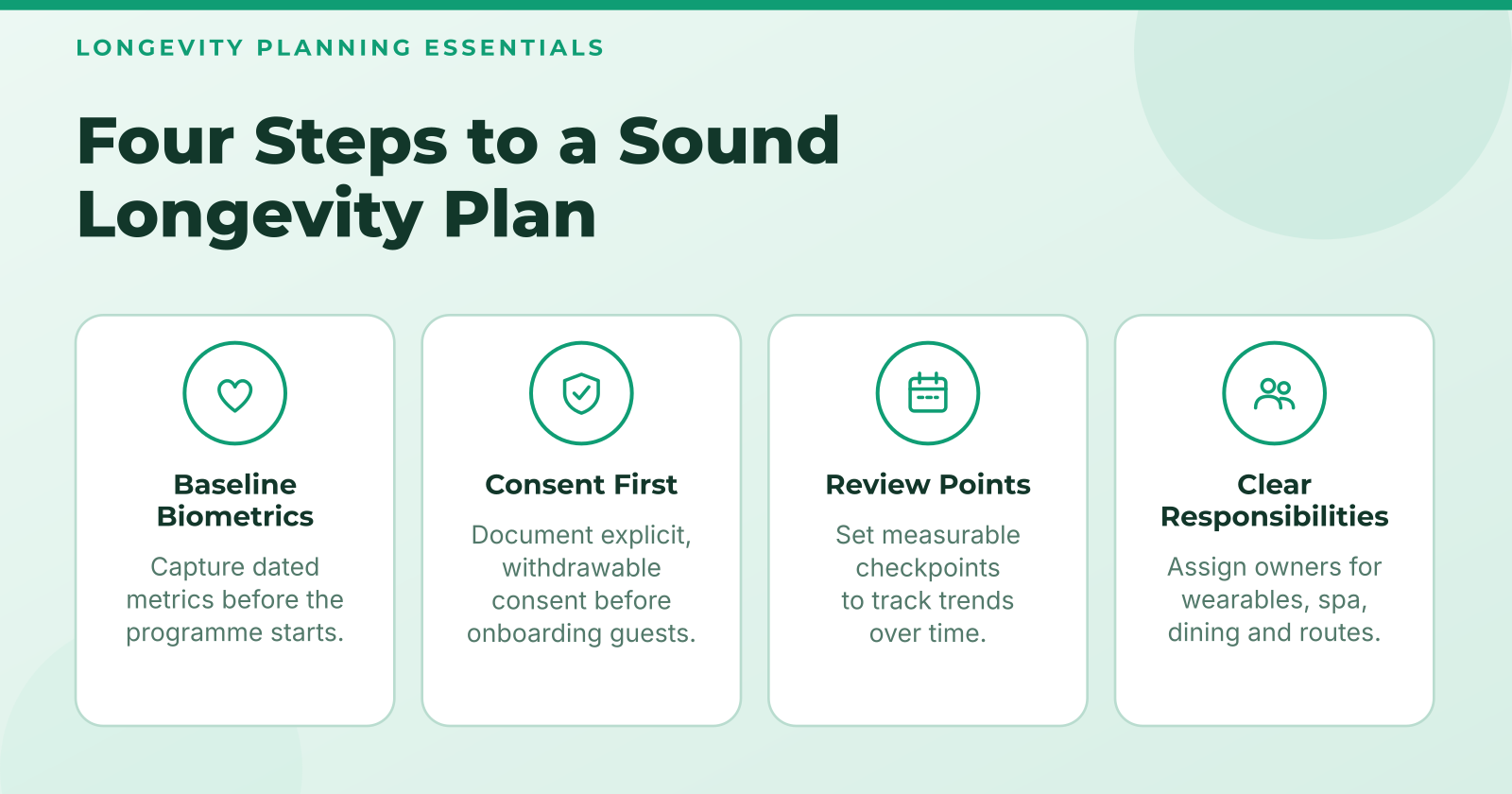
A longevity plan involves at least three roles that are often conflated: the party who approves the plan, the party who executes it, and the party who owns the data. In a hotel context these may be the general manager, the spa director, and the group data protection officer. Approval authority should sit with someone who can accept the clinical and legal risk, which in most EU jurisdictions means a licensed clinician for anything that resembles medical advice. Execution staff, such as spa therapists or concierge teams, need written boundaries on what they may recommend and what must be escalated. Data ownership should be explicit in the contract with any AI vendor, specifying whether the vendor is a processor acting on the hotel's instructions and what happens to the data when the contract ends.
Decision rights become concrete when something goes wrong. If a wearable flags an irregular heart rhythm during a spa treatment, someone must have the authority to stop the session and the obligation to contact the guest's physician or local emergency service. A plan that does not name that person is not a plan. Writing these escalation paths down before launch, and testing them with a simulated alert, is one of the cheapest safeguards available.
Scope and time horizon
The planning horizon determines which outcomes are realistic to measure. A one-year horizon suits a guest's stay or a seasonal wellness package and can track sleep, stress markers, and engagement with routes. A five-year horizon fits a membership model where the hotel or resort aims to show sustained changes in recovery and adherence, and it requires a data retention policy that can support longitudinal analysis without violating the GDPR's storage limitation principle. Ten years or more is rarely appropriate for a commercial programme, because the consent, the devices, and the clinical guidance will all change within that period, and a plan written against them will be obsolete.
Measurable outcomes should be chosen at the start and kept to a small number. Three to five outcome measures, each with a stated direction of improvement and a minimum change worth acting on, is a workable range. Anything beyond that dilutes attention and makes it difficult to tell signal from noise when the review arrives.
Longevity Planning Sequence: Step-by-Step Execution
Once inputs and roles are settled, execution follows three stages that should not be run in parallel. Assessment comes first, intervention design second, and monitoring third, and each stage produces an artefact that the next one depends on. Skipping ahead, for example by designing spa routes before the risk map exists, is the most common way programmes end up recommending interventions that do not address the client's actual exposures. The sequence is also what makes the plan auditable: a reviewer can see why a given intervention was chosen and what evidence supported that choice.
Stage 1, assessment and risk mapping
Assessment translates the baseline into a risk map. Indicators should be drawn from a validated set, and the planner should be able to state for each one the population on which it was validated and how closely the guest population matches it. Thresholds need to be set in advance and recorded, for instance a resting heart rate range that triggers a review or a sleep duration below which a recommendation changes. Thresholds set after seeing the data are a form of post-hoc reasoning that inflates apparent effects. Risks are then prioritised by the combination of severity, likelihood, and the degree to which the programme can influence them. A high-severity risk that the spa cannot affect should be routed to the guest's physician rather than addressed through a wellness package.
The output of this stage should be a short document, usually one page per guest for individual plans or one page per segment for group programmes, listing the indicators, thresholds, priority risks, and the rationale for each. This document is the reference against which every later decision is checked.
Stage 2, intervention design
Intervention design matches each priority risk to one or more actions the programme can deliver. Actions might include a sequenced wellness route combining a sleep-focused treatment, a dining plan with specific nutritional adjustments, and a daily movement target tracked through the guest's wearable. Each intervention should state its expected mechanism, the indicator it is meant to move, and the time frame over which that movement would be visible. An intervention that cannot name its target indicator is a product feature, not a longevity intervention.
Sequencing and dependencies matter because interventions interact. A high-intensity session scheduled the evening before a guest's sleep-focused treatment will confound the sleep data and undermine the purpose of both. Planners should map these dependencies explicitly, and where two interventions compete for the same recovery window, they should be separated in time or one of them deferred. The AI upsell layer adds a further dependency: any automated recommendation must be checked against the guest's documented constraints and consent scope before it is shown, so that an offer for a treatment the guest has excluded does not reach them.
Stage 3, monitoring and adjustment
Monitoring sets a review cadence appropriate to the indicators. Fast-moving measures such as sleep and heart rate can be reviewed weekly, while slower markers such as body composition are better reviewed monthly or at the end of a defined block. Trigger points for revision should be specified in advance: a sustained move outside a threshold, a guest-reported adverse effect, or a change in the guest's clinical status all warrant an unscheduled review. Documentation should record each review, the data it was based on, the decision taken, and who took it, so that the history of the plan can be reconstructed if a question later arises.
Adjustment should be conservative. A single anomalous reading is more likely to reflect device error, travel, or illness than a real change in the guest's condition, and changing the plan on that basis produces churn without benefit. A reasonable rule is to require two or three consecutive readings in the same direction before modifying an intervention, unless the reading crosses a safety threshold, in which case the escalation path applies immediately.
What to Check: Criteria for Evaluating a Longevity Plan
Evaluating a plan before launch, and again at each review, requires criteria that go beyond whether the guest seemed satisfied. The three areas that matter most are the quality of the evidence behind the chosen indicators and interventions, the regulatory and ethical position of the programme in the EU, and whether the plan is feasible and worth its cost. A plan can score well on one and poorly on the others, and a responsible planner will not proceed on the strength of a single area. Before committing to any platform, it is worth checking how it handles consent records and data minimisation, and you can learn more about these safeguards in the vendor's documentation.
Evidence quality
Evidence quality depends on source reliability, study design, and applicability. A peer-reviewed trial with a randomised design and a clearly described population carries more weight than an observational report from a device manufacturer, and both carry more weight than a marketing claim. The applicability question is often the weakest link: a sleep intervention validated in a clinical population of older adults may not transfer to healthy business travellers staying for two nights. Planners should note the population and setting of each source they rely on and flag where the guest population differs.
Wearable-derived metrics deserve particular scrutiny. Many consumer devices report proprietary scores whose underlying algorithms are not publicly documented, which makes it difficult to judge what a given number represents. Where a plan depends on such a score, the planner should either obtain the vendor's validation documentation or treat the score as a relative trend within an individual rather than an absolute measure to compare across guests.
Regulatory and ethical compliance in the EU
Regulatory position turns on what the programme claims to do. If a wellness route is presented as preventive wellness, it sits in one regulatory category, but if it claims to diagnose, treat, or monitor a clinical condition, it may fall under the Medical Devices Regulation and require conformity assessment for any software involved. Supplements offered through a dining or spa programme are governed by food and supplement law that differs between member states, and the planner should confirm the rules in each country where the programme operates. Marketing language is part of this assessment: claims about longevity or disease prevention made without substantiation can attract enforcement under consumer protection rules.
Ethical compliance adds requirements that the law may not fully cover. Guests should be told when an AI system is shaping the offers they receive, and they should be able to decline personalised recommendations without losing access to the core service. Informed consent should be renewed when the programme's scope changes materially, not only at enrolment. Records should show that consent was obtained freely, which means the guest was not made to feel that declining would affect their booking or their treatment quality.
Feasibility and cost-effectiveness
Feasibility asks whether the plan can be delivered with the resources the hotel or spa actually has. Staff time for reviews, the cost of devices, data storage, vendor fees, and the training needed for therapists to operate within the plan's boundaries all count. A programme that requires a clinician to review every guest's data weekly may be sound in principle and unworkable in a resort with a small clinical team. Planners should estimate these costs against a realistic guest volume and identify which costs scale with the number of participants and which are fixed.
Exit criteria are part of feasibility. The plan should state the conditions under which it will be stopped or substantially changed: a regulatory change, a sustained failure to reach the outcome measures, a rise in complaints, or a vendor leaving the market. A plan without exit criteria tends to continue by inertia after it has stopped doing what it was designed for.
Common Mistakes in Longevity Planning and How to Avoid Them
The mistakes that recur in longevity programmes are not exotic. They follow from a small number of shortcuts that feel efficient at launch and become costly later. Three are worth naming because they appear across hotels, spas, and corporate wellness projects alike, and each has a specific countermeasure that a planner can put in place before the first guest arrives.
Overreliance on single metrics or unvalidated markers
Programmes often build their logic around one number, usually a headline score from a wearable or a single biomarker, and treat movements in that number as the outcome. This is risky for two reasons. A single metric captures one dimension of a multi-factor state, so improving it can mask deterioration elsewhere, such as an increase in stress that a sleep score does not show. And if the metric is unvalidated, its movements may reflect the algorithm rather than the guest. The countermeasure is to define a small panel of indicators covering different systems and to require agreement across at least two of them before concluding that an intervention worked.
Skipping consent documentation and data-protection review
Consent and data protection review are the steps most likely to be deferred under commercial pressure, particularly when a pilot is already running with live guests. This produces a programme whose data flows cannot be justified if a regulator or a guest asks how their information is used. The countermeasure is to make consent and the data protection impact assessment a gate that the programme cannot pass without completion, not a parallel task. The AI vendor's processing terms should be reviewed in the same gate, including where data is stored, whether it leaves the EU, and how deletion is handled at the end of a guest's stay or membership.
Plans without review dates or ownership, leading to drift
Programmes without named owners and scheduled reviews drift. The indicators stop being checked, the thresholds stop being enforced, and the interventions continue on autopilot long after the evidence behind them has been reconsidered or the guest's situation has changed. The countermeasure is simple but needs discipline: every plan should carry a named owner, a next review date, and a documented process for triggering an earlier review. A review that is cancelled should be rescheduled with a recorded reason, so that the gap itself is visible.
Practical Checklist for Longevity Planning
The checklists below consolidate the steps described above into working lists for the three phases of a programme: before launch, during operation, and at closure. They are meant to be copied into a project document and completed, not read once and set aside.
Pre-launch checklist (inputs, approvals, consent, scope)
- Baseline biometrics captured within a defined window before the programme starts, with device type, sampling frequency, and processing method recorded.
- Data sources ranked by reliability, with provenance noted for each input stream.
- Approval authority named, with a licensed clinician confirmed where the plan resembles medical advice.
- Execution boundaries written for each staff role, and escalation paths tested with a simulated alert.
- Data owner identified, and processor terms with any AI vendor reviewed for storage location, EU transfer, and deletion.
- Explicit, specific, withdrawable consent obtained from each guest, covering data categories, purpose, retention, and recipients.
- Data protection impact assessment completed before onboarding.
- Planning horizon fixed, with three to five outcome measures and their minimum meaningful changes defined.
- Thresholds recorded in advance, not set after data has been seen.
Operational checklist (indicator thresholds, review schedule, documentation)
- Review cadence set per indicator: fast-moving measures weekly, slower markers monthly or at block end.
- Revision triggers defined, including a sustained threshold breach, a reported adverse effect, and a change in clinical status.
- Revisions require two or three consecutive readings in the same direction, unless a safety threshold has been crossed.
- Interventions checked for dependencies, including recovery-window conflicts between treatments.
- Automated recommendations checked against documented constraints and consent scope before they are shown to a guest.
- Every review documented with the data used, the decision taken, and the person responsible.
- Claims in marketing material reviewed against the regulatory category the programme falls under in each member state.
Closing criteria (when to stop, escalate, or revise the plan)
- Stop the programme if a regulatory change makes it non-compliant and cannot be remediated within an acceptable period.
- Escalate immediately to the named clinician if any safety threshold is crossed or a guest reports a serious adverse effect.
- Revise the plan if outcome measures fail to move over the defined horizon, or if the evidence base for an intervention is weakened.
- Revise the plan if complaints about data use or personalised offers rise above a level the owner has agreed in advance.
- Close the programme with a documented data deletion or retention decision for every participant, in line with the consent given.
Conclusion
A workable longevity plan is built in a fixed order: inputs and consent first, then assessment and risk mapping, then intervention design, then monitoring with pre-agreed revision rules. Planners who define thresholds in advance, name owners and review dates, and state their exit criteria will find that most of the difficult decisions have already been made by the time they arise. For professionals responsible for these programmes, the most useful next step is to take the checklists above and test them against a single pilot guest before scaling, because the gaps that appear at that scale are the ones that determine whether the programme can be defended later.


Коментарі
Дописати коментар